
Healthy Soy
Climate-resilient soybean for improved growth and health of children in Uganda
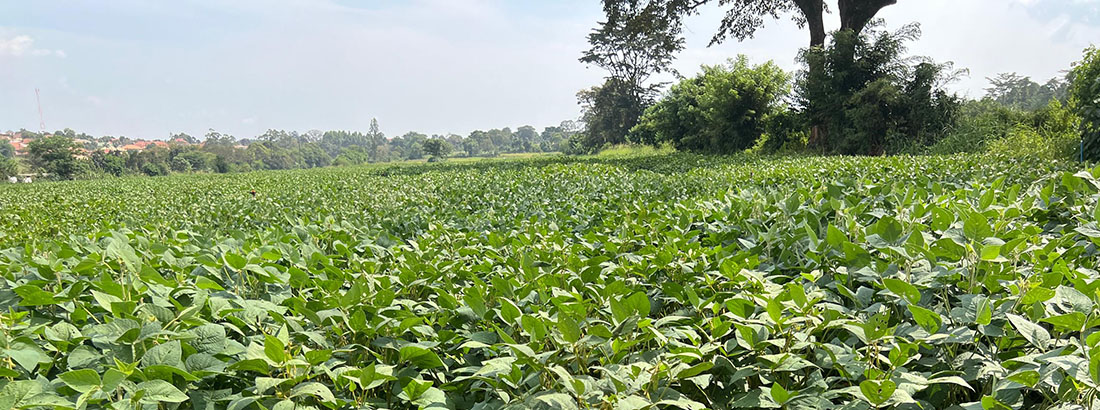
The Healthy Soy project will select climate-resilient soybean varieties with high nutritional value, optimize processing procedures to further enhance their nutritional value, develop soy-based food supplements and test their effects on growth and health of Ugandan children with malnutrition.
Emerging climate changes are causing prolonged droughts, unpredictable rains and natural disasters, resulting in lower crop yields, lower nutrient density, food insecurity and malnutrition.
There is substantial inequity in how these climate changes affect populations. Smallholder farmers cannot afford irrigations systems and therefore suffer more from droughts, children are more vulnerable to malnutrition as they require nutrient dense foods to grow and develop normally, and women are affected as they are both involved in growing crops and are primary caretakers of children.
Stunting (growth faltering) is a common form of malnutrition, which affects around 30% of children below 5 years in Africa and 26% in Uganda. In order for children with stunting to catch-up in growth, they need protein of high quality. The highest protein quality is found in animal source foods like milk. However, this is usually not affordable in low-income settings. Soy protein is of higher quality than most other plant protein sources, but antinutrients can affect its bioavailability.
The Healthy Soy research project is conducted in Uganda and covers research to
i) select climate-resilient soybean varieties with high protein and low antinutrient levels,
ii) further reduce antinutrient levels and improve protein bioavailability by food processing technologies and evaluate to which extent soy protein can support catch-up growth of children with stunting,
iii) formulate new locally produced soy-based food supplements and test their effect on growth and health of children with stunting iv) build research capacity in Uganda and disseminate results to a wide range of stakeholders.
In Uganda, stunting rates are high, soy production is widespread and research on climate-resilient soybeans is in progress.
Finally, local production of food supplements would be more cost-effective and sustainable if based on locally grown and processed soy instead of imported milk powder.
This 5-year project is organized into 4 work packages
- Climate-resilient soybeans
- Soy protein and antinutrients
- Effects of soy-based supplements on children’s growth and health
- Capacity building and dissemination
In WP1, we will identify climate-smart soybean breeding lines for adaptability and farmers acceptability under severe climate conditions in Uganda and select 3 high-protein, low-antinutrient climate-resilient soybean varieties. To identify these varieties, we will conduct genome-wide association studies (GWAS), field and screen house experiments, protein and antinutrient analyses.
WP2 comprises experiments with different soybean varieties to reduce antinutrient content through dehulling, use of different extrusion protocols and combinations hereof. Antinutrient levels and in vitro protein digestibility is determined before and after processing. Evaluation of soy protein quality and its ability to cover protein gap for catch-up growth in children with stunting is evaluated based on a scoring method.
WP3 is centered on a randomized controlled trial (RCT) among 300 young children with stunting. It is designed as a double-blind, 2-arm parallel-group trial assessing the effect soy-based LNS with high vs low levels of antinutrients on growth and health over 3 months. A third group receiving standard of care (SOC) is included as control. The effects on linear growth, body composition, morbidity and health-related biomarkers are assessed
Capacity strenthening in WP4 will include education of 3 Ugandan PhD students. In addition, cross-disciplinary seminars on healthy climate-resilient soybeans and protein and child malnutrition will be held in Uganda to broaden the research to an extended audience. Results of the project will be disseminated through scientific publications and presentations as well as dissemination workshops. In addition, technical and policy briefs will be prepared.
Internal researchers
| Name | Title | Phone | |
|---|---|---|---|
| Benedikte Grenov | Associate Professor | +4520456654 | |
| Inge Tetens | Professor | +4535332127 | |
| Nanna Roos | Associate Professor | +4535332497 |
External researchers
| Name | Institution |
|---|---|
| Prof. Phinehas Tukamuhabwa | Department of Crop Science and Horticulture, Makerere University, Uganda |
| Dr. Dorothy Nakimbugwe | Department of Food Technology and Nutrition, Makerere University, Uganda |
| Dr. Ezekiel Mupere | Child Health and Development Centre, Makerere University, Uganda |
| Prof. Daniel Tomé | AgroParisTech Université Paris-Saclay, France |
| Alex Birungi Kisembo | RECO Industries, Kampala, Uganda |
Contact
Benedikte Grenov
Associate Professor